
Hypromellose (vegetable capsule)
The shell itself, made from plant cellulose rather than animal gelatin. It is what lets the label print “Vegetable Capsule”.
No gelatin is listed anywhere on the panel.
We read the ingredient list straight off the label artwork and grouped all twelve lines so you can see what is printed, in what amount, and what is not published.
Vigorus prints twelve ingredient lines. Two are nutrients with exact amounts: vitamin B3 as niacin at 20 mg (125% DV) and zinc as zinc oxide at 11 mg (100% DV). Six amino acids and botanical extracts sit inside a 570 mg proprietary blend. Four more are listed under other ingredients, covering the vegetable capsule shell and the powder aids.
The Vigorus Supplement Facts panel carries twelve ingredient lines, and once you know how they are grouped the label reads easily. Two lines are standard nutrients, printed with a milligram amount and a percentage of the Daily Value. Six lines sit inside one proprietary blend with a single shared total. Four more appear below the box under “Other ingredients”, which is where the capsule shell and the manufacturing aids are declared.
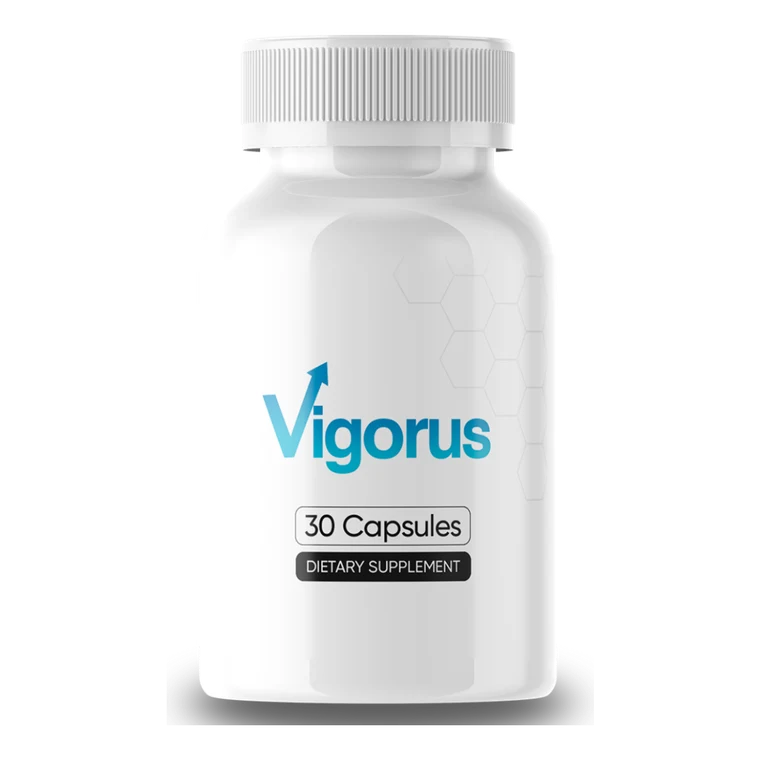
Two plus six plus four is twelve. That is the entire formula — there is no second panel on another side of the bottle and no ingredient list hidden in small print. The bottle is white with a white cap and a teal Vigorus wordmark, marked “30 Capsules” and “Dietary Supplement”. One capsule is one serving, so thirty capsules cover thirty servings.
If you would rather see the panel itself than a summary of it, we transcribe every printed line — including the caution, the storage sentence and the FDA statement — on the Vigorus Supplement Facts page.
These are the only two ingredients on the label with a published milligram figure and a Daily Value percentage beside them.
| Serving size | 1 capsule |
| Servings per container | 30 |
| Vitamin B3 (as Niacin) | 20 mg · 125% DV |
| Zinc (as Zinc Oxide) | 11 mg · 100% DV |
| Proprietary Blend | 570 mg · Daily Value not established |
| Other ingredients | Hypromellose (Vegetable Capsule), Microcrystalline Cellulose, Magnesium Stearate, Silicon Dioxide |
Percent Daily Values on the panel are based on a 2,000 calorie diet. Read directly off the label artwork supplied by the advertiser; we checked it on 29 November 2026.
Niacin and zinc are the two ingredients you can count precisely, because the panel gives a number for each. A %DV figure tells you how much of a day’s reference intake one capsule supplies: 125% for niacin means one capsule carries a quarter more than the daily reference amount, and 100% for zinc means one capsule matches it.
Both nutrients have established roles in the body, documented by the NIH Office of Dietary Supplements. Niacin, the B vitamin also written as vitamin B3, is used across energy metabolism in every cell. Zinc is involved in protein synthesis, immune function, wound healing and normal reproductive development, which is part of why it shows up so often in men’s formulas. That research describes the nutrient, not this finished capsule — a point worth holding on to anywhere you read ingredient science.
Zinc oxide is the salt used here. It is one of the standard supplement forms of the mineral, and the panel does the arithmetic for you: the 11 mg figure is elemental zinc, not the weight of the compound. Each nutrient gets its own page with the label figure and what the reference sheets cover: niacin at 20 mg and zinc at 11 mg.
One row per printed line, in the order the panel uses. This is the table we built from the artwork rather than from a marketing page.
| Ingredient | What it is | Where it sits on the label |
|---|---|---|
| Vitamin B3 (as Niacin) | A B-complex vitamin the body uses throughout energy metabolism | Printed nutrient — 20 mg, 125% DV |
| Zinc (as Zinc Oxide) | An essential mineral; zinc oxide is a common supplement form | Printed nutrient — 11 mg, 100% DV |
| L-Citrulline | An amino acid found in food and widely used in sports and circulation formulas | First component of the 570 mg blend |
| L-Carnitine | An amino-acid derivative involved in moving fatty acids into the mitochondria | Second in the blend |
| Pine (Pinus pinaster) Bark Extract | An extract of maritime pine bark, rich in plant polyphenols | Third in the blend |
| Maca (Lepidium meyenii) Root Extract | A root vegetable from the Peruvian Andes, used dried and extracted | Fourth in the blend |
| Grape (Vitis vinifera) Skin Extract | An extract from wine-grape skins, a familiar source of polyphenols | Fifth in the blend |
| Saffron (Crocus sativus) Stigmas Extract | An extract of the dried stigmas of the saffron crocus flower | Sixth in the blend |
| Hypromellose | Plant cellulose film that forms the vegetable capsule shell | Other ingredients |
| Microcrystalline Cellulose | A plant-fibre bulking agent that fills the capsule evenly | Other ingredients |
| Magnesium Stearate | A flow agent that stops powder sticking during encapsulation | Other ingredients |
| Silicon Dioxide | An anti-caking agent that keeps the powder dry and free-flowing | Other ingredients |
US labelling convention asks for the components of a blend in descending order of weight, so the printed order itself ranks them: L-citrulline is the largest share of the 570 mg and saffron extract the smallest. The individual milligram amounts are not printed, so we do not state them.
The panel prints one total for the blend, so the amount of each component is not published. That is a deliberate, perfectly ordinary way to lay out a Supplement Facts panel, and it is worth understanding rather than guessing around.
What you do get is specific: the complete list of names, each with its botanical species where a plant is involved, in ranked order, under one declared weight of 570 mg. Add the two printed nutrients and you know every active substance in the capsule and the total weight of the blend they sit in. What the panel withholds is the split between the six — the recipe ratio, which is the part a formulator treats as its own work.
Anywhere a figure is not published, we say so and point you to the label in your hand or the seller’s own page. We do not estimate, and we do not divide 570 mg by six and present the result as a label value.
“Other ingredients” is the non-active group. None of them is there for an effect on you; they exist so that a measured powder can become a capsule that survives a shelf.
The shell itself, made from plant cellulose rather than animal gelatin. It is what lets the label print “Vegetable Capsule”.
No gelatin is listed anywhere on the panel.
Purified plant fibre used as a bulking agent. It fills the remaining space so every capsule holds the same measured dose instead of a half-empty one.
A lubricant that keeps the powder from sticking to the encapsulation machinery. Present in very small quantities, as it is in a large share of capsules and tablets on the shelf.
An anti-caking agent — essentially a very fine mineral powder that keeps the blend dry and free-flowing so it does not clump in the bottle.
Five minutes with the bottle in your hand tells you more than any page can. Here is the order we use.
Read this before you add any capsule to your habit
Vigorus is a dietary supplement for adults 18 and over, and it is not for pregnant or nursing mothers. Talk to a physician or pharmacist before starting it if you take nitrates, an erectile-dysfunction medicine, blood pressure medication or a blood thinner, or if you have a medical condition — the label asks for exactly that. Bring the ingredient list with you so the conversation is about real names and amounts. And if erection problems are new or getting worse, book an appointment on its own merit: they can be an early sign of a circulation or hormone problem that deserves a proper look.
Package options, shipping and the current price are set by the seller and can change at any time. Open their order page to see the terms that apply today, and read the panel on the bottle when it arrives.
Check Price & OrderView current pricing and available packages on the seller's website.
We may earn a commission if you purchase through our link. Affiliate disclosure. The link opens the seller’s website (Vigorus order page).
Twelve printed lines: two nutrients (niacin and zinc), six components inside the 570 mg proprietary blend, and four other ingredients for the capsule shell and the powder.
In label order: L-citrulline, L-carnitine, pine (Pinus pinaster) bark extract, maca (Lepidium meyenii) root extract, grape (Vitis vinifera) skin extract and saffron (Crocus sativus) stigmas extract.
That is not published. The panel prints one 570 mg total for the blend rather than an amount per component, so the only honest answer is that L-citrulline is the largest share of that total by label order.
No caffeine is listed on the label, and no stimulant appears among the twelve lines. The complete list is the one on this page.
The shell is listed as hypromellose (vegetable capsule), which is plant cellulose, and no gelatin appears on the panel. For a strict diet, check the bottle in your hand and ask the seller about the facility.
None of those is listed among the twelve ingredient lines. The label does not carry an allergen statement beyond the ingredient list, so anyone with a serious allergy should ask the seller directly before ordering.
One capsule supplies 20 mg of vitamin B3 as niacin, which the panel marks as 125% DV, and 11 mg of zinc as zinc oxide, marked 100% DV.
Because no established Daily Value has been set for that blend as a whole, which is normal for botanical and amino-acid mixtures. It is a note about the reference figure, not about the quantity, which is printed as 570 mg.