
Skip to content
Vigorus360 Independent review · United States

Every printed line on the Vigorus label, explained

The whole panel, transcribed from the label artwork and set beside a column that says in plain words what each printed line actually tells you.

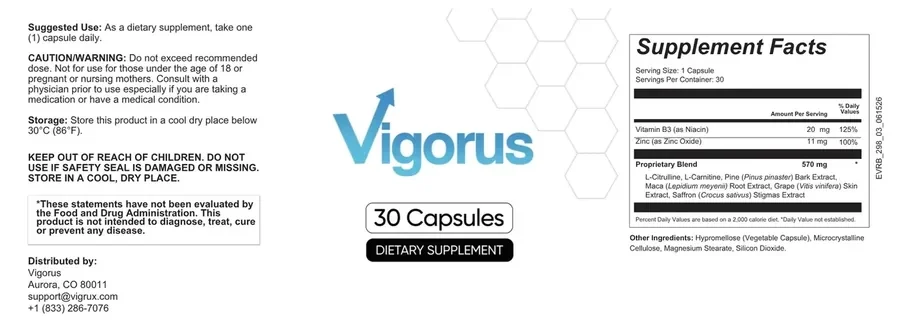
The Vigorus Supplement Facts panel prints a serving size of 1 capsule, 30 servings per container, vitamin B3 as niacin at 20 mg (125% DV), zinc as zinc oxide at 11 mg (100% DV) and a proprietary blend of 570 mg marked “Daily Value not established”. Six blend components, four other ingredients and the standard caution, storage and FDA lines are printed around it.

Vigorus label artwork unwrapped: the front panel with the teal wordmark beside the Supplement Facts panel, suggested use, caution and distributor lines

What the Vigorus Supplement Facts panel is, and what it is for

A Supplement Facts panel is the one part of a supplement bottle that is not marketing. Its format is set by regulation: a serving size, the number of servings in the container, every nutrient with an amount and a Daily Value percentage, then any proprietary blend with its total weight, then the non-active ingredients below the box. Everything in that box has to be there, and nothing in it is chosen for how it sounds.

That is why we start here rather than on a sales page. If a claim exists anywhere, the panel is where you check what the capsule is actually made of. The Vigorus panel is compact: one serving is one capsule, thirty capsules fill the bottle, two nutrients carry exact figures, and one blend line carries a single total of 570 mg for six named components.

We transcribed it from the label artwork the advertiser supplied through the affiliate network, and checked that transcription on 29 November 2026. If the panel on your bottle differs from what you read below, trust the bottle in your hand — and the grouped view of the twelve ingredient lines on the Vigorus ingredients page is the companion to this one.

The Vigorus panel line by line, with what each line means

Left column: exactly what is printed. Right column: what that line tells a buyer.

Printed lineValueWhat this line means
Serving Size1 capsuleEvery figure in the panel describes one capsule. Nothing has to be divided or multiplied.
Servings Per Container30Thirty capsules in the bottle. At one a day, that is a thirty-day supply.
Vitamin B3 (as Niacin)20 mg · 125% DVThe B vitamin, in the niacin form, at a quarter above the daily reference intake for adults.
Zinc (as Zinc Oxide)11 mg · 100% DVElemental zinc, supplied as zinc oxide, at exactly the adult daily reference intake.
Proprietary Blend570 mg · *One combined weight for the six components named under it. The asterisk points to the footnote below the box.
L-Citrullinepart of the 570 mgFirst in the blend, so the largest share by weight under standard labelling order.
L-Carnitinepart of the 570 mgSecond in the blend. The NIH publishes a fact sheet on this amino-acid derivative.
Pine (Pinus pinaster) Bark Extractpart of the 570 mgThird. The botanical name is printed, which is what makes an extract checkable.
Maca (Lepidium meyenii) Root Extractpart of the 570 mgFourth. Root extract of the Andean plant, again with the species named.
Grape (Vitis vinifera) Skin Extractpart of the 570 mgFifth. Skin extract, not seed extract — the panel is specific about the plant part.
Saffron (Crocus sativus) Stigmas Extractpart of the 570 mgSixth and last, so the smallest share of the blend by label order.
FootnotePercent Daily Values are based on a 2,000 calorie diet. *Daily Value not established.The reference frame for every %DV figure, plus the explanation of the asterisk on the blend line.
Other ingredientsHypromellose (Vegetable Capsule), Microcrystalline Cellulose, Magnesium Stearate, Silicon DioxideThe non-active group: the shell plus three powder aids, printed below the box rather than inside it.

The amounts of the six blend components are not printed. The panel gives one total for the blend, so the amount of each component is not published and we do not estimate one.

What %DV means, and what 'Daily Value not established' means

%DV is a percentage of the Daily Value — the reference intake used on US nutrition and supplement labels, set against a 2,000 calorie diet. It exists so that one number can tell you whether a serving carries a little of something or a lot of it, without you memorising milligram targets for forty nutrients.

Reading the two figures on this panel

  • Niacin 20 mg, 125% DV. One capsule supplies a quarter more than the full daily reference amount for an adult.
  • Zinc 11 mg, 100% DV. One capsule supplies precisely the daily reference amount, which is a meaningful dose rather than a decorative dusting.

“Daily Value not established” is the asterisk footnote, and it attaches to the proprietary blend. It means no established Daily Value has ever been set for that mixture, which is the normal situation for botanical extracts and most amino acids — the reference figures cover vitamins and minerals. It says nothing about how much is in the capsule. That part is printed plainly: 570 mg.

So the panel is doing two different jobs in two different lines. For niacin and zinc it gives you both an amount and a yardstick. For the blend it gives you an amount and tells you honestly that no yardstick exists. The dosage page shows how to use those two %DV figures when you already take a multivitamin.

Vigorus label verification: a laboratory microscope on a bench, standing for ingredient documentation and testing

What is printed around the box: use, caution, storage

Four blocks of text sit outside the Supplement Facts panel. These are the ones people skip and then ask about later.

Suggested use“As a dietary supplement, take one (1) capsule daily.”
Caution“Do not exceed recommended dose. Not for use by those under the age of 18 or pregnant or nursing mothers. Consult with a physician prior to use, especially if you are taking a medication or have a medical condition.”
StorageStore this product in a cool, dry place below 30 °C (86 °F).
Capital-letter linesKEEP OUT OF REACH OF CHILDREN. DO NOT USE IF SAFETY SEAL IS DAMAGED OR MISSING. STORE IN A COOL, DRY PLACE.
Distributed byVigorus, Aurora, CO 80011
Reference code on the label sideEVRB_298_03_061526
FDA statement“These statements have not been evaluated by the Food and Drug Administration. This product is not intended to diagnose, treat, cure or prevent any disease.”

Quoted from the label artwork supplied by the advertiser, checked 29 November 2026. The caution and the FDA statement are reproduced word for word because paraphrasing either one would change what it says.

The capital-letter lines, the distributor and the reference code

Three short lines are set in capitals, and each one is a practical instruction rather than a legal formality. Keep out of reach of children applies to every bottle of capsules in the house. Do not use if safety seal is damaged or missing is the check to run before the first capsule, not after. Store in a cool, dry place repeats the storage line for people who never read the side panel — below 30 °C, which rules out a car glovebox and a windowsill in July.

Distributed by Vigorus, Aurora, CO 80011

US supplement labels have to name a responsible company, and this one names the brand with a Colorado address. That is the line to quote in any email about a delivery, a refund or a question on the formula, and it is the detail that tells you a real company stands behind the bottle. The brand’s own site and the order page are the right places for commercial questions; we cover how that path works on the where to buy Vigorus page.

EVRB_298_03_061526

A reference code is printed on the label side. Codes like this identify an artwork or production run internally. It is not a certificate, a registration number or a lot result, and we do not present it as one — but it is worth writing down, because it is how you tell later whether the bottle in front of you carries the same printed panel as the one we transcribed.

Why the FDA statement is on the bottle

Every dietary supplement sold in the US that makes a structure-function claim carries that disclaimer, word for word. It means the claim has not been reviewed by the agency and the product is not intended to diagnose, treat, cure or prevent any disease. Supplements are not approved before sale the way prescription drugs are; the manufacturer is responsible for the product and the FDA acts afterwards. That is the rule for the whole category, and the FDA approval page explains how it works in more detail.

What the panel publishes, and what it does not

A side-by-side you will not find on a sales page. Both columns are useful; neither is a complaint.

Published, and exact

Serving size, servings per container, niacin at 20 mg with 125% DV, zinc at 11 mg with 100% DV, the 570 mg blend total, all six component names with botanical species, all four other ingredients, suggested use, caution, storage, distributor and the FDA statement.
Not published on the label

The milligram split between the six blend components, the extract strength or standardisation of the botanicals, and the manufacturing facility. Those are questions for the seller rather than gaps you can fill by arithmetic.

Where a figure is not printed, we say so and stop.

Printed but often misread

The asterisk on the blend line. It points at the footnote about Daily Values, not at the quantity — the quantity is right there in the same row.

How the daily capsule is meant to work →

Worth photographing

The whole panel plus the side code. Formulas are revised from time to time, and a photo of today’s label is the only way to compare a future bottle against this one.

See the twelve ingredient lines grouped →

The caution on the label is the short version of this

Vigorus is for adults 18 and over and is not for pregnant or nursing mothers. Speak with a physician or pharmacist before you start if you take nitrates or an erectile-dysfunction medicine, blood pressure medication or a blood thinner, or if you have a medical condition — the label asks for that in writing. Do not exceed one capsule a day. And treat new or worsening erection problems as a reason to see a doctor in their own right: they can be an early signal of a circulation or hormone problem worth investigating properly.

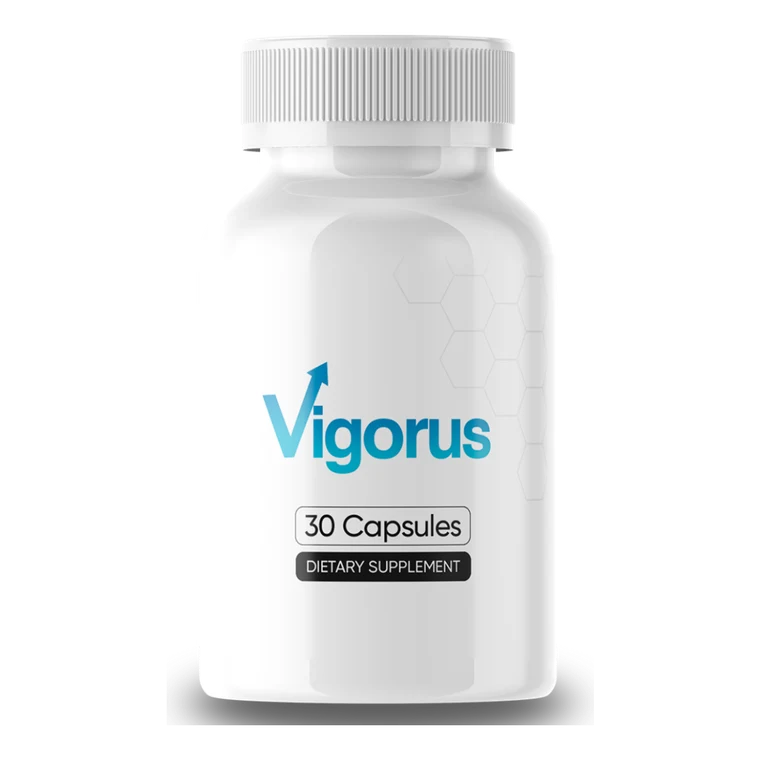
Vigorus capsules: white bottle with the teal Vigorus logo, 30 capsules, dietary supplement

Check the Vigorus offer and read the panel on arrival

The seller sets packages, shipping and the current price, and those terms change. Open their order page for today's conditions, then compare the printed panel on the bottle with the transcription above.

Check Price & Order

View current pricing and available packages on the seller's website.

We may earn a commission if you purchase through our link. Affiliate disclosure. The link opens the seller’s website (Vigorus order page).

Vigorus label questions in context: a modern pharmacy wellness aisle where a pharmacist can read the panel with you

Vigorus Supplement Facts: common label questions

What is the serving size of Vigorus?

One capsule. The panel prints 1 capsule as the serving size and 30 servings per container, so every figure on the label describes a single capsule.

How much is in the Vigorus proprietary blend?

570 mg in total, shared by six components: L-citrulline, L-carnitine, pine bark extract, maca root extract, grape skin extract and saffron stigmas extract.

Why does the blend line have an asterisk?

The asterisk points to the footnote reading “Daily Value not established”. No published reference intake exists for that mixture, which is normal for botanicals and amino acids.

Does Vigorus contain 100% of my daily zinc?

One capsule supplies 11 mg of zinc, which the panel marks as 100% DV for adults. If you also take a multivitamin with zinc, add the two figures together before you start.

What does the Vigorus label say about how to take it?

Verbatim: “As a dietary supplement, take one (1) capsule daily.” The caution adds “Do not exceed recommended dose.”

Who distributes Vigorus?

The label reads “Distributed by Vigorus, Aurora, CO 80011”. That is the company named as responsible for the product on the bottle.

What is the code EVRB_298_03_061526 on the label?

A reference code printed on the label side. Codes like it identify artwork or a production run internally; it is not a certificate or a registration number, and we do not read it as one.

How should Vigorus be stored?

In a cool, dry place below 30 °C (86 °F), with the cap closed. The capital-letter lines repeat that, and add keeping the bottle out of reach of children.

Why does the label say the statements have not been evaluated by the FDA?

Because that disclaimer is required on US supplements that carry structure-function claims. Supplements are not approved before sale the way medicines are, so the sentence appears on the whole category, not just this bottle.

Sources

  1. NIH ODS — Dietary Supplements: What You Need to Know — how to read a Supplement Facts panel, serving sizes and %DV figures in plain language
  2. FDA — Dietary Supplements — the US framework for supplement labelling, required statements and who is responsible for a product
  3. NIH Office of Dietary Supplements — Niacin — reference intakes for vitamin B3 and the adult upper limit, for reading the 20 mg line in context
  4. NIH Office of Dietary Supplements — Zinc — adult zinc requirements, the oxide and other supplement forms, and the upper limit
  5. NCCIH — Using Dietary Supplements Wisely — what to check on a label and what to raise with a clinician before starting a supplement
  6. FTC — Health Products Compliance Guidance — the advertising rules that govern how supplement claims may be worded in the US

Keep reading